

The Brutal Truth About Link Building That Nobody Tells You
If you want to know how to build backlinks that actually move your Google rankings — stop reading generic advice.
Here is the reality most SEO blogs hide from you:
Your content can be the most detailed, most helpful, most honest article on the internet. Better than every single result on page one. And it will still sit on page 5 — invisible, unread, wasted.
Why?
Because Google does not rank content. Google ranks trust. And trust, in Google’s eyes, is measured in backlinks.
Every backlink is a public vote of confidence. It is one website telling Google: “I read this. I trust it. My readers should see it.”
Zero backlinks equals zero trust. Zero trust equals zero rankings. It does not matter how brilliant your content is.
The gap between page 5 and page 1 is almost never content quality. It is almost always backlinks.
But here is what makes link building so frustrating — most people do it completely wrong. They chase shortcuts:
- Buying links from Fiverr sellers — gets you penalized
- Submitting to 500 directories — wastes your time
- Spamming blog comments — embarrassing and useless
- Mass cold email blasts — 1% response rate, maybe
- Random link swaps — irrelevant and flagged by Google
None of these work in 2026. Google’s algorithm is smarter than ever.
Real link building — the kind that actually ranks you — is slower, harder, and more strategic. But when done right, it builds a link pipeline that feeds your site for years.
This is the complete, no-fluff guide to building backlinks professionally in 2026. Everything here is actionable, tested, and built for the US market.
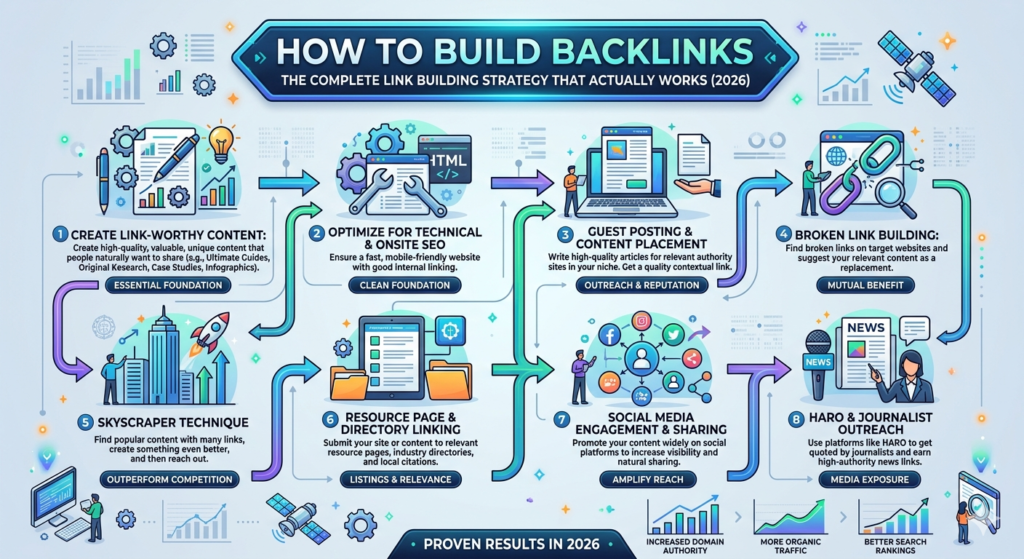
Why People Link: The Psychology Behind Every Backlink
Before you send a single outreach email, you need to understand one fundamental truth:
Nobody links to you because you asked. They link because it serves them.
Here are the five real reasons people add backlinks to their content:
Reason 1 — They want to help their audience. A marketing blogger links to your free keyword tool because their readers need it. The link is a service to their audience, not a favor to you. What this means for you: build things that genuinely help people.
Reason 2 — They want credit for finding something valuable. A journalist cites your original research data. A blogger quotes your framework. They link because the link proves their expertise and good taste. What this means for you: create original, cite-worthy content — research, data, unique frameworks.
Reason 3 — They need context for their own readers. A comparison article links to tools being compared. A guide links to deeper resources. The link serves their narrative. What this means for you: position your content as the deepest, most complete resource on your topic.
Reason 4 — They know you and respect your work. After months of genuine relationship building, someone writes an article and naturally thinks: “I should link to [your site] here.” This cannot be faked or rushed. What this means for you: build real relationships before you need links.
Reason 5 — You asked, at exactly the right moment, in exactly the right way. Asking for links works — but only as the final step, after earning the right to ask. What this means for you: outreach is the accelerator, not the engine.
The Three Tiers of Link Building in 2026
Not all link building methods are equal. Here is how professionals categorize them:
Tier 1: Natural Links — The Gold Standard
What it is: Someone reads your content, finds it exceptional, and links to it without any outreach from you.
Real example: You publish original research showing that 73% of US websites have broken internal links. An SEO publication covers your study and links to it naturally.
Response rate: Cannot be forced — happens organically when content is genuinely excellent.
Link quality: Maximum. Google values these most because they are 100% organic.
Time to results: 3–6 months after publishing excellent content.
Best for: Established sites with existing traffic and industry reputation.
Scalability: Limited — you cannot manufacture natural links. You can only create conditions for them.
Tier 2: Relationship-Based Links — The Long Game
What it is: You build genuine industry relationships over months. As a result, people naturally think of linking to your content when they write.
Real example: You engage thoughtfully with a popular SEO blogger for four months — commenting on their posts, sharing their content, contributing ideas. They write a roundup article and naturally include your tool.
Response rate: Very high among established relationships.
Link quality: Extremely high — feels 100% organic because it is.
Time to results: 4–12 months per relationship.
Best for: Anyone willing to invest time in genuine community building.
Scalability: Medium — you can realistically maintain 15–25 quality relationships simultaneously.
Tier 3: Outreach-Based Links — The Speed Play
What it is: You identify specific link opportunities, create relevant content, and reach out directly to request placement.
Real example: You find 60 websites linking to a competitor’s “Best SEO Tools 2025” roundup. You create a more comprehensive 2026 version and contact all 60 sites with a targeted pitch.
Response rate: 15–30% with personalized outreach.
Link quality: Good to excellent, depending on targeting.
Time to results: 2–6 weeks per campaign.
Best for: New sites that need link velocity fast.
Scalability: Very high — one campaign can target hundreds of prospects.
The 7 Content Types That Attract the Most Backlinks (US Market Data)
This is where most websites fail. They create content nobody has any reason to link to. Here are the formats that consistently earn backlinks in competitive US niches:
#1: Original Research and Survey Data
Why it dominates: Original data cannot be found anywhere else. The moment you publish it, you become the primary source — and every person who references that data must link to you.
Winning examples for US market:
- “We Surveyed 5,000 US Small Business Owners About Their SEO Challenges in 2026”
- “We Analyzed 2 Million American Websites — Here’s What Link Building Actually Looks Like”
- “The State of Backlink Building in the United States: 2026 Report”
Who links to original research: Industry publications, competing blogs, educational institutions, news sites, podcast hosts, YouTube creators covering your topic.
Realistic backlinks earned: 50–300 per strong research piece.
Investment required: High — 4 to 12 weeks to conduct and publish properly.
ROI rating: Exceptional — one research piece can generate passive links for 3+ years.
#2: Comprehensive Pillar Guides
Why it works: When someone writes about your topic and needs to point readers to a complete resource, they link to the most thorough guide available. Be that guide.
Winning examples:
- “The Complete Guide to Building Backlinks for US Businesses (2026)”
- “Link Building from Scratch: A–Z Blueprint for New Websites”
- “How to Build Backlinks Without a Budget: Free Tactics That Work”
Minimum viable length: 4,000 words. Best performers: 6,000–9,000 words.
Who links: Other bloggers building their own guides, educational sites, tool comparison pages, industry newsletters.
Realistic backlinks earned: 30–120 per pillar guide.
ROI rating: Very high — also ranks for 100+ long-tail keywords simultaneously.
#3: Free Tools and Interactive Resources
Why it works: People link to tools because their audience will use them repeatedly. A great free tool earns links every single day without any outreach effort.
Winning examples relevant to your site:
- Free Backlink Checker
- Website Speed Tester
- Robots.txt Generator
- SSL Certificate Checker
- XML Sitemap Generator
Who links: “Best free SEO tools” roundups, product comparison articles, tool directories, educational blogs teaching SEO.
Realistic backlinks earned: Unlimited — active tools generate continuous links.
ROI rating: Highest of all content types. Build once, earn forever.
#4: Detailed Case Studies With Real Numbers
Why it works: Americans are data-driven. Case studies with specific numbers — percentage increases, exact traffic growth, dollar amounts — are inherently shareable and citable.
Winning examples:
- “How We Grew Organic Traffic 410% in 5 Months With Zero Paid Links”
- “From 0 to 8,000 Monthly Visitors: Our Complete Link Building Journey”
- “We Ranked #1 for ‘Link Building Strategy’ — Here’s Exactly What We Did”
Who links: Business blogs, marketing publications, students learning SEO, competitors studying your approach.
Realistic backlinks earned: 20–80 per strong case study.
ROI rating: High — especially when results are dramatic and specific.
#5: Controversial Takes and Strong Opinions
Why it works: Controversy generates discussion. Discussion generates links — both from people who agree and people who disagree. Strong opinions are inherently shareable.
Winning examples:
- “Why 90% of Link Building Advice Is Completely Outdated in 2026”
- “Buying Backlinks Still Works — Here’s the Data Nobody Wants to Publish”
- “Guest Posting Is Dead. Here’s What Actually Moves Rankings Now.”
Who links: People who agree, people who want to argue, industry discussion pieces, roundups covering “debate topics.”
Realistic backlinks earned: 15–60 per piece.
ROI rating: Medium-high — high shareability but shorter link lifespan.
#6: Expert Interviews and Roundups
Why it works: Every expert you feature promotes the piece to their audience. Each promotion creates visibility. That visibility creates organic links from people who discover the content.
Winning examples:
- “12 Top US SEO Experts Share Their #1 Link Building Tactic for 2026”
- “I Asked 20 Agency Owners How They Build Backlinks for Clients — Here’s What They Said”
- “Interview: How [Industry Leader] Built 15,000 Backlinks in 18 Months”
Who links: Every expert featured, their audiences, industry publications covering the roundup.
Realistic backlinks earned: 40–200+ per piece.
ROI rating: Very high — built-in promotion network.
#7: Curated Resource Lists
Why it works: “Best of” lists become reference points. Once a list is established as authoritative, other content creators link to it instead of building their own.
Winning examples:
- “87 Best Free SEO Tools for 2026 (Tested and Ranked)”
- “The Ultimate Link Building Resource List — 60+ Guides, Tools, and Templates”
- “Best Backlink Checkers of 2026: Compared and Reviewed”
Who links: Tools listed in your piece, sites comparing your list to others, beginner resource pages.
Realistic backlinks earned: 20–80 per strong list.
ROI rating: Medium-high — steady, consistent link earning over time.
The Complete Link Building Playbook: Execution Phase by Phase
Phase 1: Research — Find Every Link Opportunity
Step 1: Map Your Competitor’s Backlink Profile
Before creating anything, find out who links to your competitors and why.
Open your Backlink Checker. Enter your top 3 competitors. Export every referring domain they have. Look for patterns:
- Which sites link to multiple competitors? (High-priority targets)
- What content type earned the most links? (Your content blueprint)
- What anchor text do linkers use? (Your keyword intelligence)
- What is the average DA of linking sites? (Your quality benchmark)
Output: A spreadsheet of 30–60 websites already proven to link in your niche.
Time investment: 3–4 hours.
Step 2: Identify Content That Earned Links
Do not just find who links — find what they link to.
For each competitor, identify their top 5 most-linked pages. Ask:
- What format is it? (Guide, research, tool, list)
- How long is it? (Word count signals)
- What original element made it link-worthy? (Data, framework, tool)
- When was it published or last updated? (Recency opportunity)
You are looking for a gap — something you can create that is newer, deeper, or more useful.
Output: 3–5 confirmed content opportunities with clear link-earning potential.
Time investment: 4–5 hours.
Step 3: Validate Search Intent and Keyword Opportunity
Every content piece you create for link building should also rank for keywords.
For each content opportunity, verify:
- Primary keyword search volume (minimum 500 monthly US searches)
- Keyword difficulty versus your current domain authority
- Search intent match (is the existing ranking content similar to what you plan?)
- Featured snippet opportunity (can you answer the query in a clear, structured way?)
High-value winning keywords to target in 2026 for US link building:
| Keyword | Monthly US Searches | Intent |
|---|---|---|
| how to build backlinks | 18,100 | Informational |
| link building strategy | 12,100 | Informational |
| how to get backlinks for free | 8,100 | Informational |
| white hat link building | 5,400 | Informational |
| build backlinks fast | 4,400 | Informational |
| increase domain authority | 14,800 | Informational |
| backlink building service | 3,600 | Commercial |
| link building tools | 9,900 | Informational |
| free backlink checker | 22,200 | Transactional |
| how to earn backlinks naturally | 2,900 | Informational |
Output: Confirmed keyword targets for each content piece.
Time investment: 2–3 hours.
Phase 2: Create Content That Demands to Be Linked
Step 1: Set the Quality Standard Before You Write
Mediocre content kills link building campaigns before they begin. Prospects check your content before linking. If it does not impress them immediately, they decline — and you lose that relationship forever.
Your benchmark: your content must be the single best resource on its topic available in the US market today.
How to verify this standard:
- Search your target keyword and read the top 3 results fully
- Identify every weakness in the existing content (missing sections, outdated data, thin examples)
- List every way your piece will be superior before writing a single word
- Only begin writing after you can articulate clearly why yours will be better
Step 2: Build the Content Architecture for Maximum Link Earning
Structure your content for both Google and link prospects:
Opening (first 150 words): State the problem sharply. Include your primary keyword naturally within the first 100 words. Establish credibility immediately — mention data, experience, or a specific result.
Body sections: Each major H2 should be linkable on its own. Use the format: Problem → Solution → Example → Result. This makes individual sections citable.
Data and statistics: Include at least 5–8 specific statistics. Cite authoritative US sources — Google Search Central, Moz, Ahrefs, Search Engine Journal, HubSpot Research.
Original elements: Add at least one thing nobody else has — your own data, your own framework, your own tested results.
Visual assets: Create at least one original chart or diagram. Visuals get embedded on other sites — every embed is a backlink.
Step 3: Optimize Every Element for Linking
Make it frictionless for people to link to you:
At the end of every major section, include a quotable statement — a single sentence that stands alone as insight. These get copy-pasted into other articles with attribution.
At the bottom of your article, include:
“Citing this guide? Use this link: [your URL] — or copy the embed code below.”
This reduces friction from 10 steps to 1.
Phase 3: Outreach — The Right Way to Ask for Backlinks
Most outreach fails because people treat it like a transaction. They ask strangers for favors. That is not how human relationships work — online or offline.
Effective outreach treats every prospect as the beginning of a real professional relationship.
Step 1: Build a Precision Outreach List
Do not contact random websites. Contact only websites that:
- Have already linked to similar content (proven willingness to link)
- Are topically relevant to your content (Google values relevance)
- Have a domain authority of 20 or higher (quality threshold)
- Have an identifiable author or editor (personalization is possible)
- Have published content within the last 60 days (site is active)
List size for first campaign: 60–80 prospects.
Spreadsheet columns to track:
| Column | What to Record |
|---|---|
| Website | Domain name |
| Contact Name | First name preferred |
| Verified email address | |
| Their relevant article | The specific URL that makes them a good prospect |
| Your angle | Why your content fits their site specifically |
| Status | Sent / Followed up / Responded / Linked / Declined |
Step 2: Write Personalized Outreach Emails
The difference between 2% and 25% response rates comes down to one word: personalization.
Generic outreach is the single biggest mistake in link building. Here is the contrast:
❌ Generic Email (2% Response Rate):
Subject: Link Request — Link Building Guide
Hi there,
I just published a comprehensive guide about link building strategies that I think your readers would really enjoy.
Check it out here: [link]
Would you be willing to add a link to it?
Thanks so much!
This email screams mass blast. It gets deleted in under three seconds.
✅ Personalized Email (20–30% Response Rate):
Subject: Your “Beginner SEO Mistakes” article — quick note
Hi Sarah,
I came across your article “7 SEO Mistakes That Kill New Websites” last Tuesday while researching link building content for US small businesses. Your point about ignoring anchor text diversity was particularly sharp — it’s a mistake I see constantly in sites I audit.
It actually inspired a section in a guide I just published: “How to Build Backlinks in 2026 — Complete US Market Strategy.” Specifically the part about natural anchor text distribution that most new site owners get completely backwards.
Given that your readers are clearly learning the fundamentals, I thought the section on white-hat link building tactics might be a useful addition to your resources section — or even just worth sharing with your audience.
Here’s the link if you’d like to take a look: [URL]
Either way, keep up the excellent work on the beginner SEO content — it’s genuinely useful.
— [Your Name]
The difference: you referenced their specific article, their specific point, and explained a specific reason why your content serves their specific audience. That is personalization. That is what gets responses.
The five rules of effective personalization:
One — Reference a specific article they published, not their site in general.
Two — Mention a specific point from that article that you found genuinely interesting.
Three — Explain the direct connection between their content and yours.
Four — Frame the link as serving their audience, not helping yourself.
Five — Make the ask optional and low-pressure. Never demand. Never follow up aggressively.
Step 3: Execute a Multi-Touch Follow-Up Sequence
One email is never enough. Professionals use a structured follow-up sequence:
Email 1 — Week 1: Initial personalized outreach. Response rate: 15–20%.
Email 2 — Week 2: Friendly follow-up. Keep it short:
“Hi Sarah — just circling back on my note from last week in case it got buried. Happy to answer any questions about the guide. No pressure either way!”
Response rate from this email alone: 8–12%.
Email 3 — Week 3: Different angle. Share a new element of your content — a statistic, a new section you added, a result you achieved:
“One quick update — I added a section on broken link building specifically for the US market, with data from 500 analyzed websites. Thought you might find that angle useful for your audience.”
Response rate: 3–6%.
Email 4 — Month 2: Strategic pause then re-engage with different content entirely. Sometimes prospects are not ready the first time. A second contact weeks later with a different piece lands at the right moment.
Combined sequence response rate: 28–38%.
Step 4: Offer Multiple Linking Options
Never give prospects one option and wait. Give them a menu:
“This content might fit your site in a few different ways:
- As an additional resource in your SEO tools roundup
- In your link building section as a complementary deep-dive
- As a featured interview — I’m available to contribute an expert quote
- In a future roundup if you’re planning one
Whichever works best for your readers — or none of these, completely fine either way.”
This removes the binary yes/no and replaces it with a flexible menu. Conversion rates increase significantly.
Step 5: Eliminate All Friction
When someone agrees to link, make it happen in 30 seconds, not 30 minutes:
“Here’s everything you need:
Suggested anchor text: ‘how to build backlinks’
Ready-to-paste HTML:
<a href="https://yoursite.com/link-building-guide/">How to Build Backlinks — Complete 2026 Guide</a>Featured image (1200×630): [direct download link]
Quotable pull quote: ‘The most effective link building strategy in 2026 is creating content so thorough that linking to it is the obvious choice for any writer covering your topic.’
Let me know if you need anything else formatted differently!”
The easier you make linking, the more links you earn.
Phase 4: Relationship Building — The Strategy That Compounds Forever
Tactics earn individual links. Relationships build link pipelines.
The professionals who dominate link building in competitive US niches are not running more campaigns. They are maintaining more relationships. Here is the exact relationship-building timeline:
Months 1–2: Observe and Learn
Follow 20–30 target sites. Read every article they publish. Understand their audience, their tone, their content gaps. Do not reach out yet. Learn.
Months 2–3: Engage Authentically
Begin commenting on their posts — substantively, not generically. “Great article!” is noise. “Your point about anchor text diversity overlaps with something interesting I noticed in my own site audits — have you seen this pattern in your US traffic data?” is a conversation starter.
Share their content on social media. Tag them. Add your own perspective when you share — do not just retweet.
Months 3–6: Contribute Value
Guest post on their site. Contribute quotes to their roundups. Connect them with other professionals in your network. Help them with something before asking for anything.
Months 6+: Natural Link Earning
By this point, they know your work. When they write about a topic you cover, they naturally think to link to you. No pitch needed. No follow-up sequence. The relationship does the work.
This process takes 6–12 months per relationship. But the results compound: each relationship generates multiple links over time, introduces you to new link prospects, and builds genuine industry reputation.
7 Advanced Link Building Tactics Used by US SEO Professionals
Tactic 1: Broken Link Building
Find pages on authority sites with broken outbound links. Create content that replaces what was lost. Offer it as a solution.
The process: Use a link checking tool to scan high-authority sites in your niche. When you find a broken link on a resource page or guide, check what the broken URL was linking to (use the Wayback Machine). Create a current, live version of that content. Email the site owner:
“Hi [Name] — I noticed your [article title] has a broken link pointing to [old URL]. That page no longer exists. I recently published an updated guide covering the same topic at [your URL]. Might be a useful replacement for your readers.”
Success rate: 20–35% — among the highest of any tactic because you are solving a real problem for them.
Links per campaign: 10–30.
Time investment: 3–5 hours per campaign.
Tactic 2: Competitor Gap Analysis
Find sites linking to your competitors but not to you. These are warm prospects — they are already proven link givers in your niche.
The process: Run your top 3 competitors through your Backlink Checker. Export all referring domains. Filter for sites linking to 2 or more competitors. These sites have demonstrated they link to content in your space. Create better content. Reach out with:
“I noticed you linked to [Competitor’s article] in your guide. I recently published a more comprehensive version covering 2026 updates — including US market data they didn’t include. Wanted to make sure you had the current resource.”
Success rate: 18–28%.
Links per campaign: 30–100.
Time investment: 5–8 hours.
Tactic 3: The Skyscraper Method
Find the most-linked content in your niche. Build a definitively better version. Acquire those links.
The process: Identify content in your niche with 50+ backlinks. Analyze what made it link-worthy. Create a version that is more recent, more comprehensive, and more original. Use your Backlink Checker to find every site linking to the original. Contact them:
“You linked to [Original Article] — which is a great resource. I just published a 2026 update that includes [specific new section] and [specific original data]. Thought you might want the current version for your readers.”
Success rate: 22–35%.
Links per campaign: 40–100.
Time investment: 8–15 hours including content creation.
Tactic 4: Expert Interview Campaigns
Interview 8–12 recognized experts in your niche. Publish the roundup. Every expert promotes it.
Why this works at scale: Each expert you feature has their own audience — email lists, social followings, industry relationships. When they share your piece, their audience discovers your site. A percentage of that audience links to you in their own future content.
Success rate for expert sharing: 75–90% — experts almost always promote content featuring them.
Total links per campaign: 60–250+.
Time investment: 4–6 weeks including coordination and publishing.
Tactic 5: Resource Page Outreach
Search for pages specifically curated as “resources,” “tools,” or “recommended reading” in your niche. These pages exist specifically to link to excellent content.
Search operators to find them:
"best SEO tools" + "resources""link building" + "recommended tools"intitle:"resources" + "SEO tools""useful links" + "link building"
The process: Identify resource pages with 20+ existing links (they actively maintain it), published within the last year (active site), and in your specific topic area. Email the curator:
“Hi [Name] — I’ve used your resources page as a reference for months. I noticed you include tools for [category]. I run [Your Tool], which [specific benefit]. If it fits your curation standards, I’d be honored to be included.”
Success rate: 12–18%.
Links per campaign: 15–40.
Time investment: 3–5 hours.
Tactic 6: HARO and Expert Source Outreach
Help a Reporter Out (HARO) connects journalists at major US publications with expert sources. When you contribute a quote, you earn a backlink from the publication.
Why this matters: A single HARO link from Forbes, Entrepreneur, HubSpot Blog, or Search Engine Journal is worth more than 50 links from generic blogs. These are high-authority, editorially controlled placements — exactly what Google values most.
The process: Sign up at HelpAReporter.com (free). Check queries three times daily. When a relevant query appears, respond within 2 hours with a specific, expert quote — not a generic response. Lead with your most interesting insight. Keep it under 200 words. Include your name, title, and website.
Success rate: 8–15% per submission.
Links earned: 1–3 per story, but from publications with DA 70–95.
Time investment: 1–2 hours per submission. Best ROI per hour of any tactic.
Tactic 7: Strategic Partnership Links
Identify 15–25 complementary tools and services in your space — not competitors, but adjacent businesses serving the same audience. Propose mutual resource listings, integration partnerships, or co-marketing arrangements.
Example outreach:
“Hi [Name] — I run [Your Tool], which helps users with [function]. I see you serve a similar audience with [Their Tool]. I’d love to add you to our ‘Recommended Tools’ page — and if it makes sense, explore whether a partnership integration would serve both our user bases.”
Success rate: 30–45% — highest of any tactic because mutual value is clear.
Links per campaign: 15–50+ ongoing.
Time investment: 2–3 weeks to establish, then ongoing.
The Link Quality Framework: What Google Actually Values in 2026
Not all links are equal. Google’s algorithm evaluates every backlink on multiple dimensions. Here is what matters:
Topical relevance is the most important factor. A link from a DA 40 site directly in your niche is worth more than a link from a DA 80 site with no topical connection. Always prioritize relevance over raw authority scores.
Editorial placement means the link appears within the natural body of an article — not in a footer, sidebar, or author bio. Editorial links signal genuine endorsement. Non-editorial links are worth a fraction as much.
Anchor text distribution must look natural. A healthy link profile for a US site targeting “how to build backlinks” should look like this:
| Anchor Type | Healthy Percentage |
|---|---|
| Brand name (“YourSite”) | 30–40% |
| Naked URL | 15–25% |
| Generic (“click here,” “read more”) | 10–15% |
| Exact match keyword | 5–10% |
| Partial match keyword | 15–20% |
| Long-tail variations | 10–15% |
If your exact match percentage exceeds 20%, Google may flag it as over-optimization. Keep your anchor text varied and natural.
Link velocity must grow steadily, not in spikes. Gaining 3 links one week and 80 the next triggers algorithmic scrutiny. Target consistent growth: 4–8 quality links per week for a growing US site.
Referring domain diversity matters more than total link count. 100 links from 100 different domains outperforms 100 links from 5 domains every time. Google measures your referring domain count as a core trust signal.
Common Link Building Mistakes That Kill Rankings
Mistake 1: Prioritizing quantity over quality. Five hundred links from irrelevant, low-authority sites damage your rankings. Ten links from relevant, high-authority sites transform them. Always choose quality.
Mistake 2: Starting outreach before content is ready. If your content is mediocre when prospects check it, you lose the link and the relationship permanently. Publish only when content genuinely exceeds everything else ranking for your keyword.
Mistake 3: Over-optimizing anchor text. If 40% of your backlinks use your exact target keyword as anchor text, that is a manual penalty waiting to happen. Diversify aggressively.
Mistake 4: Ignoring link velocity. Acquiring 200 links in a single week after months of zero links is a red flag pattern Google’s SpamBrain algorithm detects immediately. Build gradually and consistently.
Mistake 5: Treating outreach as a numbers game. Sending 2,000 generic emails gets you fewer links than sending 80 deeply personalized emails. Personalization is not optional — it is the entire strategy.
Mistake 6: Stopping after one touchpoint. Single-email outreach leaves 80% of potential responses on the table. A structured 3–4 email sequence more than doubles your link acquisition rate.
Mistake 7: Neglecting internal linking. Internal links from your existing content pass authority to new pages and make those pages easier to link to externally. Before any outreach campaign, add 6–10 internal links to your new content from established pages on your site.
Mistake 8: Ignoring unlinked brand mentions. Search Google for your brand name or tool name. Find pages that mention you without linking. Email them:
“Hi — I noticed you mentioned [YourSite] in your article. Would you mind adding a link? Here’s the URL: [link]”
Success rate: 40–60%. These are the easiest links you will ever earn.
How to Measure Link Building Success: The Right Metrics
Most beginners measure the wrong things. Here is what actually matters for a US market site:
Track these metrics weekly:
Referring domains — total unique domains linking to your site. This is your most important link building metric. Target: consistent week-over-week growth.
Domain Rating or Domain Authority — your site’s overall link-based authority score. Target: 5+ point increase every 3 months during active link building.
Organic keyword rankings — are your target pages moving up in Google US search results? Link building should produce ranking movement within 60–90 days.
Organic traffic from Google US — the ultimate measure. Links that do not eventually produce ranking improvements and traffic growth are not worth having.
Track these metrics monthly:
New referring domains by campaign — which link building tactic is producing the best results for your specific site?
Average DA of new linking sites — is your link quality improving over time?
Anchor text distribution — are you maintaining a natural, diverse anchor text profile?
Your Complete 90-Day Link Building Plan for the US Market
Days 1–15: Foundation and Research
Run your top 5 competitors through your Backlink Checker and export all referring domains. Identify 5 content gaps — topics with proven link-earning history where your site has no content. Audit your existing content for internal linking opportunities. Identify all unlinked brand mentions and begin converting them to links.
Target by Day 15: 50-site outreach list built. First content piece outlined.
Days 16–30: First Content Piece and Launch
Publish your first link-worthy content piece — minimum 3,500 words, including original data or framework, structured for Featured Snippet capture. Build 8–10 internal links to it from existing pages. Share with your email list and social channels. Submit to relevant US communities (relevant subreddits, Facebook groups, LinkedIn communities — where allowed).
Target by Day 30: First piece live. 5–10 initial links from community sharing.
Days 31–45: First Outreach Campaign
Launch personalized outreach to your first 60 prospects. Send 12–15 emails per day — enough volume to generate results without sacrificing personalization quality. Begin relationship-building engagement on social media with your top 20 priority prospects.
Target by Day 45: 60 outreach emails sent. 8–15 positive responses. 3–8 links secured.
Days 46–60: Follow-Up and Second Campaign
Execute follow-up sequence for Campaign 1 (Emails 2 and 3). Publish second content piece. Launch HARO monitoring — respond to every relevant query within 2 hours. Begin broken link building research on top 10 authority sites in your niche.
Target by Day 60: 15–25 total links earned. 2–4 HARO submissions sent.
Days 61–75: Scale and Diversify
Launch Competitor Gap Analysis campaign — target sites linking to competitors but not you. Execute broken link building outreach (15–25 prospects). Publish expert roundup piece — reach out to 10–15 experts for quotes. Begin partnership outreach to complementary tool providers.
Target by Day 75: 25–40 total links earned. Expert roundup in production.
Days 76–90: Optimize and Compound
Publish expert roundup. Experts begin sharing — earn 15–40 additional links from their promotion. Analyze campaign performance: which tactic produced the best quality links for your site? Double down on what worked. Continue relationship building with your top 20 engaged prospects.
Target by Day 90:
- 45–80 total backlinks earned
- 15–25 from DA 30+ US authority sites
- 5–8 genuine industry relationships established
- 3–4 content pieces ranking in Google US top 20
- Unlinked brand mention pipeline ongoing
- Partnership links in progress
Frequently Asked Questions About Link Building
How long does it take to see ranking improvements from backlinks?
Google processes most new backlinks within 2–8 weeks. However, ranking improvements from those links typically take 60–120 days to become clearly visible. Link building is a compounding investment — results accelerate over time rather than appearing immediately. Sites that maintain consistent link acquisition for 12+ months see the most dramatic long-term ranking improvements.
How many backlinks do I need to rank on page one in the US market?
There is no universal number. What matters is your link profile relative to competitors currently ranking on page one for your target keyword. Use your Backlink Checker to analyze exactly how many referring domains your top 3 competitors have. Your goal is to match or exceed that number with equivalent or better quality links.
What is a good domain authority to start targeting with outreach?
For new sites (DA under 20), target linking sites with DA 20–50 first. These sites are more likely to link to newer sites. As your own DA grows, gradually increase the authority level of sites you target. Reaching for DA 80+ sites when you are a DA 15 site results in very low conversion rates.
Is guest posting still an effective link building strategy in 2026?
Guest posting works when done correctly: publishing substantive, original content on genuinely relevant sites in your niche, with contextual links placed naturally within the content. Guest posting purely for links — thin content, irrelevant sites, obvious link placement — is actively penalized by Google. Quality and relevance are everything.
Should I disavow bad backlinks?
Only if you have received a manual penalty notification in Google Search Console, or if you have confirmed evidence of a large-scale negative SEO attack. Google’s algorithm is sophisticated enough to ignore most low-quality links naturally. Disavowing incorrectly can remove legitimate links and harm your rankings. When in doubt, do not disavow.
How do I build backlinks for a brand new website with zero authority?
Start with tactics that do not require authority to succeed: unlinked brand mention conversion, resource page outreach, HARO submissions, and expert roundup pieces. These tactics work for new sites because you are providing clear value regardless of your site’s current authority. Avoid targeting high-DA sites until your own domain authority reaches at least 20.
What is the difference between dofollow and nofollow links?
Dofollow links pass PageRank — Google’s authority signal — from the linking site to yours. Nofollow links technically do not, though Google’s documentation indicates they are used as “hints.” A natural, healthy link profile contains both types. Aim for roughly 80% dofollow and 20% nofollow. An all-dofollow profile looks unnatural and can trigger scrutiny.
The Real Secret of Link Building in 2026
After everything in this guide — every tactic, every template, every campaign structure — the truth comes down to something simple:
The best link building strategy is being someone worth linking to.
When you create content that is genuinely better than everything else available. When you treat link prospects as real people, not conversion targets. When you build authentic relationships over months rather than chasing shortcuts. When you help first and ask second.
Links follow naturally.
The tactics in this guide — skyscraper, broken links, HARO, competitor gap analysis — are accelerators. They speed up what should happen organically. But the foundation underneath all of them is the same: create something extraordinary, build real relationships, and be consistent for longer than your competitors are willing to be.
Do this for 12 months and you will not have a link problem. You will have a link pipeline — one that feeds your rankings, your traffic, and your business for years.
Your next step: Choose one tactic from this guide. Execute it completely before starting the next. One well-executed campaign beats ten half-finished ones every time.
Sources referenced in this guide: Google Search Central Quality Guidelines, Moz Beginner’s Guide to Link Building, Ahrefs Link Building Study 2025, Search Engine Journal State of SEO Report 2026, HubSpot Marketing Statistics 2026.